Hawaii
Reef-safe sunscreen in Hawaii depends on which island you are on
Hawaii is not one rule. Statewide, only oxybenzone and octinoxate are banned, and only from sale. Maui and the Big Island require mineral UV filters instead, and Maui is the one place in the islands where the bottle in your bag can itself be illegal. Pack for the county, not the state.
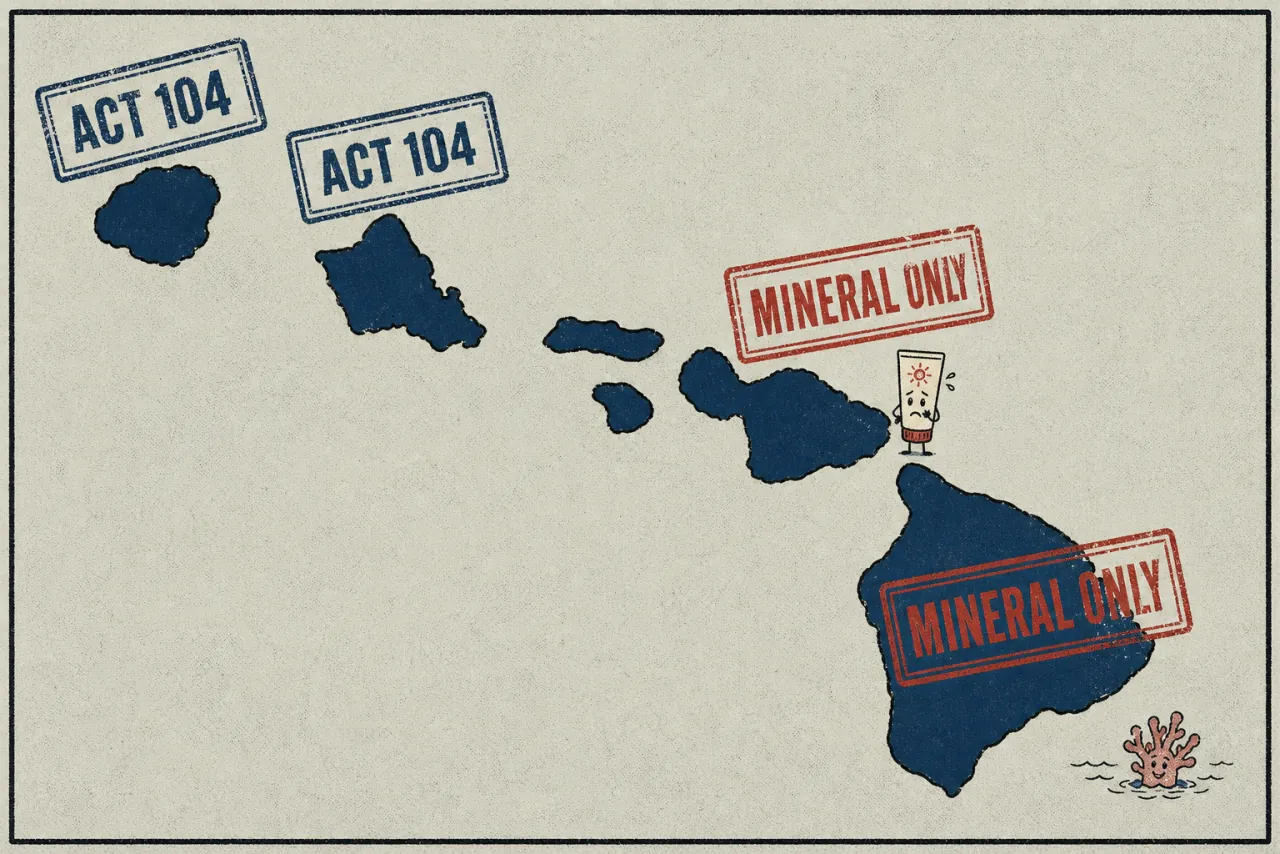
| Place | What fails | Reaches | In force | Fine |
|---|---|---|---|---|
| Statewide, Act 104 | Oxybenzone, octinoxate | Sale only | 1 Jan 2021 | Not set for buyers |
| Maui CountyMaui, Molokaʻi, Lānaʻi | Any non-mineral UV filter | Sale and use | 1 Oct 2022 | Up to $1,000, plus $1,000 a day |
| Hawaiʻi Countythe Big Island | Any non-mineral UV filter | Sale only | 1 Dec 2022 | Up to $1,000 per incident |
| Honolulu CountyOahu | Statewide list only | Sale only | No county rule | Not applicable |
| Kauai County | Statewide list only | Sale only | No county rule | Not applicable |
Mineral means zinc oxide and titanium dioxide as the UV filters. All three laws exempt sunscreen dispensed on a prescription.
Three things most Hawaii sunscreen guides get wrong
These are not nitpicks. Each one changes what you would put in a bag, and all three currently appear in Google’s own AI summary for this question.
Wrong: Maui and the Big Island also ban octocrylene
Both counties ban every UV filter that is not zinc oxide or titanium dioxide. Naming octocrylene makes it sound like avobenzone, homosalate, and octisalate are fine there. They are not. A bottle of avobenzone and homosalate with no octocrylene in it is still illegal to sell on Maui and still illegal to wear there.
Wrong: Hawaii requires mineral sunscreen
Statewide, it does not. Act 104 removed two chemicals and left the rest. Chemical sunscreen is on drugstore shelves in Honolulu right now, legally. Bills to add avobenzone and octocrylene statewide were introduced in 2021, 2022, 2024, and 2025, and every one of them died. If you read that Hawaii banned avobenzone in 2023, you have found a page citing an act that does not exist.
Wrong: you need non-nano zinc to be legal
No Hawaii statute or county ordinance mentions particle size. Maui County suggests non-nanotized minerals on its guidance page, and that is a suggestion. The ordinance defines a mineral sunscreen by which active ingredient it uses. Non-nano is a private lab standard, and it matters for Palau-grade strictness, not for whether you can put the bottle on at Kāʻanapali.
What Act 104 actually bans
Governor Ige signed SB2571 as Act 104 on 3 July 2018. Since 1 January 2021 it has been unlawful to sell, offer for sale, or distribute for sale in the state any sunscreen containing oxybenzone or octinoxate without a prescription. The statute names both chemicals by CAS number. It says nothing about avobenzone, octocrylene, homosalate, or octisalate, and it carves face cosmetics out of the definition of sunscreen entirely.
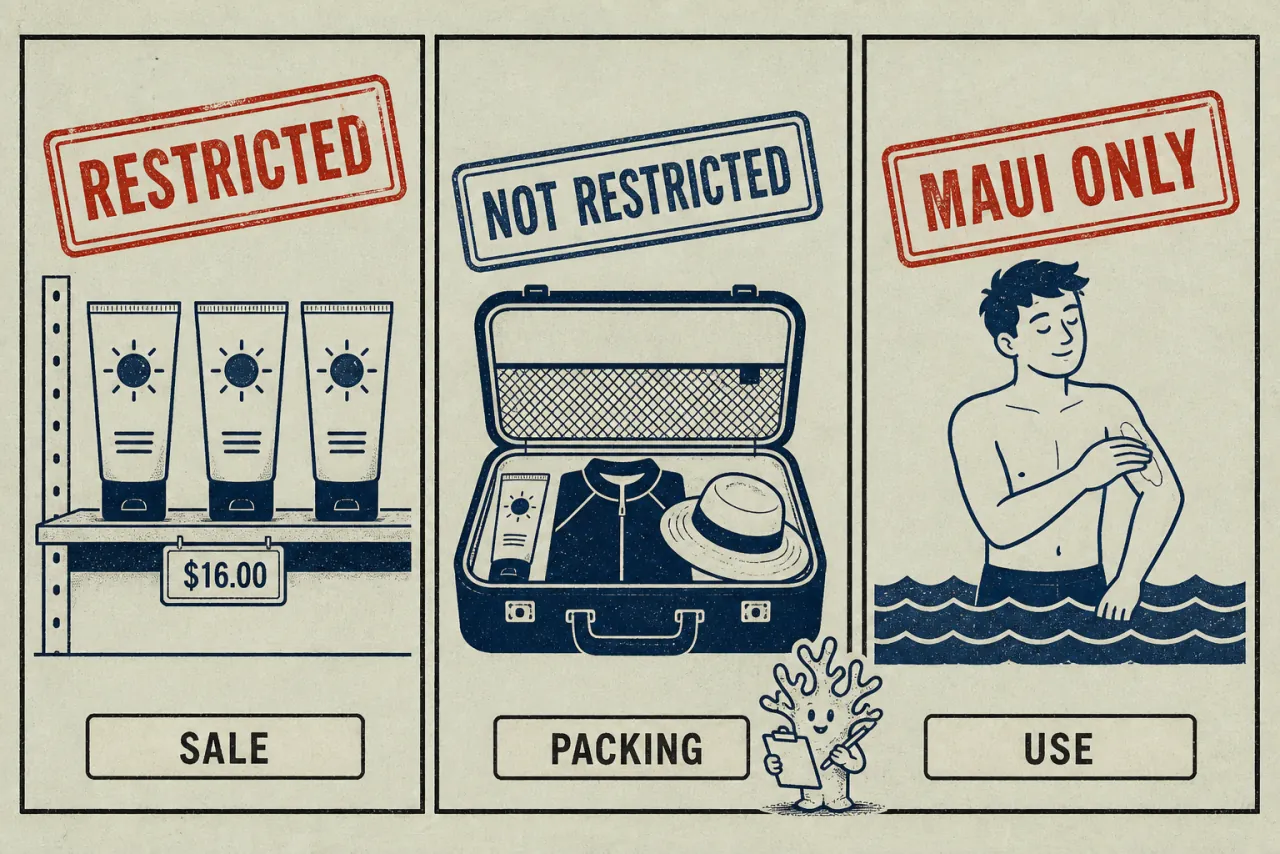
The word that does most of the work is sale. Act 104 is a shelf law. It never restricts what a visitor packs, carries, or wears. That is why the practical effect of the statewide ban, for someone flying in with their own bottle, is close to zero.
Maui is mineral-only, and it covers use
Maui County Ordinance 5306 took effect on 1 October 2022 and added Chapter 20.42 to the county code. It prohibits the sale, distribution, and the use or application of any non-mineral sunscreen without a prescription. Non-mineral means any sunscreen whose active ingredient is something other than zinc oxide and titanium dioxide. The civil fine runs up to $1,000, with up to another $1,000 for each day a violation continues.
Maui is the only jurisdiction in Hawaii that reaches use, and the ordinance covers Molokaʻi and Lānaʻi too. In practice the county said from the start that it would lead with education rather than penalties, and there is no published record of a visitor being fined. Treat it as a rule you follow because it is the rule, not because someone is checking bags at Kahului.
The Big Island copied the shelf, not the swimmer
Hawaiʻi County Bill 167 became Ordinance 22-81 on 8 July 2022, without Mayor Roth’s signature, and took effect on 1 December 2022. It uses the same mineral-only definition Maui uses, and it stops at sale, offer for sale, and distribution. Wearing a chemical sunscreen on the Big Island is not a violation. Selling one is, at up to $1,000 per incident, and the Department of Environmental Management can confiscate and destroy the stock.
That difference is small on paper and large in a suitcase. If your trip is Kona and Hilo, the county rule shapes what you can buy after you land. If your trip includes a single day on Maui, it shapes what you can wear.
Oahu and Kauai have no county rule
Honolulu County and Kauai County have not passed sunscreen ordinances. Only Act 104 applies, so a chemical sunscreen without oxybenzone or octinoxate is legal to sell and legal to wear on both islands. That is the honest answer to a question a lot of packing lists dodge, and it is why buying on arrival in Waikīkī does not get you a Maui-legal bottle.
Hanauma Bay is worth naming because it comes up constantly. The preserve asks visitors to use mineral sunscreen and to apply it well before getting in the water. That is guidance from the park, not a separate ban, and it is good advice anywhere on Oahu.
Bottles that clear every island
These are the mineral bottles in the catalog, each read off its own Drug Facts panel. Every one of them is legal to sell and legal to wear on all four islands. The Palau column is there because it is the screen that splits zinc lotions apart, usually on phenoxyethanol, and because a lot of Hawaii trips have a second stop.
| Bottle | UV filters | SPF | Water | Palau | Verified |
|---|---|---|---|---|---|
| Sun Bum Mineral SPF 30 Sunscreen Lotion | zinc oxide 14.7% | 30 | 80 min | FAIL | 2026-08-16 |
| Sun Bum Mineral SPF 50 Sunscreen Lotion | zinc oxide 20% | 50 | 80 min | FAIL | 2026-08-16 |
| Banana Boat Kids Mineral Protection SPF 50 lotion | titanium dioxide 4.5%, zinc oxide 6.5% | 50 | 80 min | FAIL | 2026-08-16 |
| Thrive Natural Care BodyShield 50 | zinc oxide 23.5% | 50 | 80 min | PASS | 2026-08-16 |
| Thrive Natural Care Daily Defense Sunscreen Balm SPF 30 | zinc oxide 20% | 30 | None | PASS | 2026-08-16 |
| Stream2Sea Every Day Active Mineral Sunscreen 16 oz | zinc oxide 19% | 30 | 80 min | PASS | 2026-08-16 |
| Stream2Sea Every Day Mineral Sunscreen 4 Kids | zinc oxide 19% | 30 | None | PASS | 2026-08-16 |
| Blue Lizard Sensitive Mineral SPF 50 Sunscreen Lotion | zinc oxide 10%, titanium dioxide 8% | 50 | 80 min | PASS | 2026-08-16 |
| Blue Lizard Sport Mineral SPF 50 Sunscreen Lotion | titanium dioxide 8%, zinc oxide 10% | 50 | 80 min | PASS | 2026-08-16 |
| Blue Lizard Sensitive Mineral SPF 50 Sunscreen Spray | zinc oxide 24% | 50 | 80 min | PASS | 2026-08-16 |
| Blue Lizard Sport Mineral SPF 50 Sunscreen Spray | zinc oxide 24% | 50 | 80 min | FAIL | 2026-08-16 |
| Hawaiian Tropic Mineral Skin Nourishing Milk SPF 50 | titanium dioxide 4.9%, zinc oxide 6.7% | 50 | 80 min | FAIL | 2026-08-16 |
| Supergoop PLAY Mineral Lotion SPF 30 | zinc oxide 16% | 30 | 80 min | PASS | 2026-08-16 |
| Supergoop PLAY Mineral Sunscreen Stick SPF 50 | zinc oxide 20.6% | 50 | 80 min | PASS | 2026-08-16 |
| Vacation Mineral Lotion SPF 30 | zinc oxide 15.5% | 30 | 80 min | PASS | 2026-08-16 |
| Vacation Shake Shake SPF 50 Mineral Milk | zinc oxide 20.5% | 50 | None | FAIL | 2026-08-16 |
| Coola Zinc Oxide Sunscreen Spray SPF 30 | zinc oxide 14.5% | 30 | 80 min | PASS | 2026-08-16 |
| Native Sunscreen Lotion SPF 30 | zinc oxide 17% | 30 | None | PASS | 2026-08-16 |
| Native Sunscreen Spritz SPF 30 | zinc oxide 20% | 30 | None | PASS | 2026-08-16 |
| Thinksport Safe Sunscreen SPF 50+ (3 oz) | zinc oxide 20% | 50 | 80 min | PASS | 2026-08-16 |
| Thinksport Clear Zinc Face Sunscreen SPF 50 (2 oz) | zinc oxide 23.4% | 50 | 80 min | PASS | 2026-08-16 |
| Thinksport Kids Safe Sunscreen SPF 50+ (6 oz) | zinc oxide 20% | 50 | 80 min | PASS | 2026-08-16 |
| Badger Face Mineral Sunscreen SPF 30 | zinc oxide 18.75% | 30 | 40 min | PASS | 2026-08-16 |
| Badger Daily Mineral Sunscreen SPF 30 | zinc oxide 18.75% | 30 | 40 min | PASS | 2026-08-16 |
| Badger Active Mineral Sunscreen Cream SPF 30 | zinc oxide 18.75% | 30 | 40 min | PASS | 2026-08-16 |
| Raw Elements Travel Size SPF 30 | zinc oxide 23% | 30 | 80 min | PASS | 2026-08-16 |
| Raw Elements Face + Body SPF 30 (3 oz) | zinc oxide 23% | 30 | 80 min | PASS | 2026-08-16 |
Maui and the Big Island share one test, so a pass on one is a pass on the other. Water resistance is what the panel claims, not what we measured.
Sunscreen that is not allowed on Maui or the Big Island
This is the table most people need, because the bottle already in the bathroom cabinet is usually on it. Most of these are legal to sell and wear on Oahu and Kauai and illegal on Maui, which is the split that catches travelers. Several carry an Act 104 badge on the front, and that badge is accurate and misleading at the same time.
Two rows fail the statewide law as well, and both are older labels that Act 104 pushed off Hawaii shelves. Banana Boat Simply Protect Sensitive Mineral is the other one worth slowing down for. It has zinc oxide in it and the word mineral on the front, and it also has homosalate and octocrylene, so it fails Maui like any other chemical bottle.
| Bottle | UV filters | Statewide | Maui and Big Island |
|---|---|---|---|
| Sun Bum Original SPF 30 Sunscreen Lotion | avobenzone 3%, homosalate 5%, octisalate 3%, octocrylene 10% | PASS | FAIL |
| Sun Bum Original SPF 30 Sunscreen Spray | avobenzone 3%, homosalate 10%, octisalate 5%, octocrylene 3.75% | PASS | FAIL |
| Sun Bum Kids SPF 50 Clear Sunscreen Lotion | avobenzone 3%, homosalate 10%, octisalate 5%, octocrylene 10% | PASS | FAIL |
| Neutrogena Ultra Sheer Dry-Touch SPF 55 lotion | avobenzone 3%, homosalate 10%, octisalate 5%, octocrylene 10% | PASS | FAIL |
| Neutrogena Ultra Sheer Body Sunscreen Mist SPF 30 | avobenzone 3%, homosalate 8%, octisalate 5%, octocrylene 8% | PASS | FAIL |
| Banana Boat Sport SPF 30 (older DailyMed label) | homosalate 8.78%, octinoxate 5%, octisalate 5%, octocrylene 2.5%, oxybenzone 5% | FAIL | FAIL |
| Banana Boat Ultra Sport SPF 30 (oxybenzone-free listings) | avobenzone 2.7%, homosalate 6%, octisalate 4.5%, octocrylene 4.5% | PASS | FAIL |
| Banana Boat Simply Protect Sensitive Mineral Enriched SPF 50 spray | homosalate 9%, octisalate 3%, octocrylene 6%, zinc oxide 7.3% | PASS | FAIL |
| Hawaiian Tropic Weightless Hydration SPF 30 lotion (US DailyMed) | avobenzone 2%, homosalate 5.5%, octisalate 4.5%, octocrylene 4% | PASS | FAIL |
| Hawaiian Tropic Island Sport SPF 30 lotion (Canada) | octocrylene 5%, oxybenzone 3%, avobenzone 2% | FAIL | FAIL |
| Supergoop Unseen Sunscreen SPF 50 | avobenzone 3%, homosalate 7%, octisalate 5%, octocrylene 9% | PASS | FAIL |
| Supergoop Glowscreen SPF 40 | avobenzone 3%, octisalate 5%, octocrylene 10% | PASS | FAIL |
| Vacation Super Spritz SPF 50 face mist | avobenzone 2.9%, octisalate 4.9%, octocrylene 9.5% | PASS | FAIL |
| Vacation Classic Face Lotion SPF 45 | avobenzone 3%, homosalate 10%, octisalate 5%, octocrylene 10% | PASS | FAIL |
| Coola Classic Clear Sunscreen Spray SPF 30 | avobenzone 2.8%, octisalate 4.9%, octocrylene 7.6% | PASS | FAIL |
| Coola Classic Face Sunscreen Lotion SPF 50 | avobenzone 1.75%, homosalate 5%, octisalate 2%, octocrylene 5% | PASS | FAIL |
A statewide pass means no oxybenzone and no octinoxate. It does not mean mineral. Paste any panel not listed here into the checker.
“Reef safe” on the front means nothing
There is no FDA definition of reef safe or reef friendly for sunscreen, and no FTC rule that defines it either. Any brand can print it on any bottle. The American Academy of Dermatology says so plainly on its own label-decoding page. The claim on the front is marketing; the Drug Facts panel on the back is the regulated part.
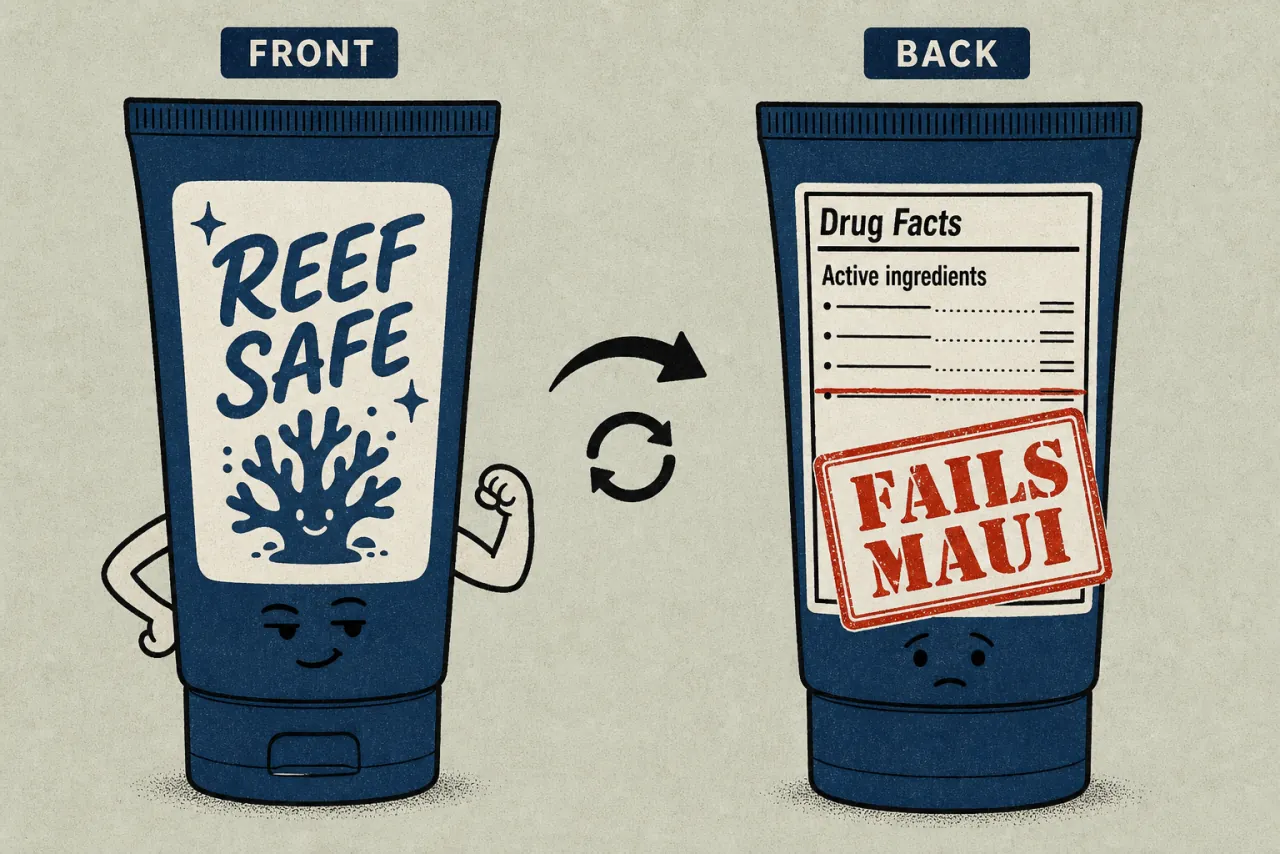
This has started to cost brands money. The Santa Clara County District Attorney in California has brought a run of false-advertising cases over exactly this claim. Sun Bum took a $300,000 judgment in May 2025 and is now barred from calling its chemical sunscreens reef friendly or putting a coral reef on them. Supergoop settled for $350,000 the following month. The case against Edgewell, which owns Banana Boat and Hawaiian Tropic, was still contested as of this writing. The theory in all three is the same: drop the two chemicals Hawaii banned, keep avobenzone and octocrylene, and keep saying reef friendly anyway.
Worth knowing if you see this described elsewhere as an FTC action. It was not. It was a county district attorney under California consumer protection law, and the distinction matters if you go looking for the filings.
Non-nano, and what it is actually good for
Non-nano is not a US legal term. The 1 to 100 nanometre threshold everyone quotes comes from European cosmetics regulation, which also requires the word nano on the ingredient line. The US has no equivalent labeling rule, particle size does not appear on a Drug Facts panel, and no brand has to prove the claim. A coating ingredient in the inactives tells you the mineral was surface-treated. It does not tell you how big the particles are.
Where it does mean something is the private lab lists. Protect Land + Sea, run by Haereticus Environmental Laboratory, tests the finished product rather than taking the manufacturer’s word, and its list excludes nanoparticle zinc and titanium along with the usual chemicals. That is a real test with a real result. It is also strictly an absence-of-ingredients test, not a coral toxicity test, so a certified bottle is a bottle that does not contain listed substances, not a bottle proven harmless to a reef.
Does sunscreen actually harm coral?
The honest answer is more open than either side of this argument usually admits, and it is worth knowing before you spend $20 on a tube.
The case for harm starts with a 2016 study by Downs and colleagues that found oxybenzone toxic to coral larvae and cultured coral cells in the laboratory. That study is what put the two chemicals into Act 104. In 2022 a team publishing in Science described a mechanism: anemones and one mushroom coral metabolize oxybenzone by attaching a sugar to it, which converts a UV filter into a phototoxin. Algal symbionts soak up the product and protect the animal, so bleached animals died faster. That result cuts in a specific direction. It says the risk is worst exactly where reefs are already in trouble.
The case against is mostly about dose and design. Critics, including coral scientist Terry Hughes, point out that the concern rests on a small number of laboratory studies using concentrations far above anything measured on a real reef, and that field sampling in the foundational work was thin. NOAA’s former Coral Reef Watch coordinator put the proportions bluntly: sunscreen is death by a thousand cuts, and climate change has been a nuclear blast.
The closest thing to a referee is the National Academies, which reviewed the whole question in 2022. It did not find that sunscreen harms reefs. It found that UV filters are detectable in water, sediment, and tissue, that presence is not the same as harm, that the available data are too limited to say whether there is a risk, and that EPA should run a proper ecological risk assessment. It also flagged the other side of the trade: discouraging sunscreen has its own cost in skin cancer.
Mineral is not a clean escape either. Uncoated and nano zinc oxide bleached coral in laboratory exposures, and coated commercial dispersions of the same mineral did not, which suggests formulation matters more than the word mineral. The same dose criticism applies to those studies as to the oxybenzone ones. What can be said without overclaiming is narrow and still useful: mineral is what Maui and the Big Island require, it is what the strict lists prefer, and it has not been shown to be harmless.
None of that changes the packing decision. The law on Maui is the law whether or not the science firms up, and a rash guard displaces more lotion than any bottle choice does.
The sun is the part people underestimate
Honolulu’s winter UV index is 6. That matches New York City’s summer peak. In summer Honolulu runs 11 to 12, which is the top of the EPA scale, the band where the agency says unprotected skin can burn in minutes. White sand and water reflect more UV back at you, so a beach reading is effectively worse than the forecast.
| City | Winter UV index | Summer UV index |
|---|---|---|
| Honolulu, Hawaii | 6 | 11 to 12 |
| Miami, Florida | 4 | 10 to 11 |
| Phoenix, Arizona | 3 | 10 |
| Atlanta, Georgia | 2 | 8 |
| New York, New York | 1 to 2 | 6 to 7 |
| Portland, Oregon | 1 | 5 to 6 |
EPA and National Weather Service, A Guide to the UV Index. Scale: 0 to 2 low, 3 to 5 moderate, 6 to 7 high, 8 to 10 very high, 11 and up extreme.
The practical version: a December trip is not a low-UV trip, and a mineral bottle that leaves a white cast is easier to reapply honestly than a clear one you forget about. If you are going to be in the water for hours, a rash guard covers more skin than you will ever manage to re-coat, and it does not wash off onto anything.
Getting it there, and buying it there
Flying with sunscreen is ordinary TSA business. Under 3.4 ounces in the quart bag for carry-on, full size in checked luggage, aerosol caps on. There is no Hawaii-specific restriction on bringing it in. The state agricultural declaration you fill out covers plants, animals, and soil, and sunscreen is not on it. If you have read that a medically necessary sunscreen over 3.4 ounces is allowed in a carry-on, that was a TSA website error the agency publicly corrected in 2021.
Buying on arrival works differently by island, which follows from the sale rules. On Maui and the Big Island the shelf has already done the filtering for you, so a bottle bought locally clears the county rule. On Oahu the shelf has only done the statewide filtering, and chain drugstores there still stock the familiar chemical brands. Convenience stores in Waikīkī carry mineral tubes at roughly $15 to $20 for three ounces, which is a few dollars an ounce above a mainland drugstore. Some beach parks on the Big Island and Maui have free mineral dispensers, though those were installed in 2021 and 2022 and nobody publishes whether a given one is stocked today. Do not plan around finding one.
If the trip has other stops
Hawaii is not the strictest place on this list, and the lists do not match each other. Palau is the one that catches people, because it bans phenoxyethanol along with the UV filters, and phenoxyethanol is a common preservative in otherwise blameless zinc lotions. Key West is the one that is quietly out of date everywhere: the 2019 ordinance was nullified by a Florida preemption law before it ever took effect.
| Place | What fails | Reaches | Since |
|---|---|---|---|
| Palau | Ten ingredients. In practice zinc and titanium only, and no phenoxyethanol, parabens, triclosan, or triclocarban | Sale, import, and bringing it in | 1 Jan 2020 |
| US Virgin Islands | Oxybenzone, octinoxate, octocrylene | Retail sale, distribution, import for retail | 30 Mar 2020 |
| Aruba | Oxybenzone | Import, manufacture, sale | 1 Jul 2020 |
| Thailand marine parks | Oxybenzone, octinoxate, 4-MBC, butylparaben | Bringing it in and using it, inside park boundaries | 4 Aug 2021 |
| Mexico, national marine parks | Sunscreen that is not biodegradable, defined per park | Use inside the park | Varies by park |
| Key West, Florida | Nothing. The 2019 ordinance was preempted by state law | No enforceable local rule | Preempted 1 Jul 2020 |
The definitions page has the full screen list, and the Labels chart scores every dated bottle against all of them at once.
What to pack
If any day of the trip is Maui, Molokaʻi, Lānaʻi, or the Big Island, bring a mineral bottle and stop thinking about it. Thrive BodyShield 50 and Stream2Sea Every Day Active clear Palau as well, so they travel further than the others. Blue Lizard Sensitive Mineral is the drugstore version of the same answer. Sun Bum Mineral is legal on every Hawaiian island and fails Palau on phenoxyethanol, which is a different trip’s problem.
If the whole trip is Oahu or Kauai, the bottle you already own is probably legal. Whether it is the one you want is a separate question, and the answer usually comes down to whether you will actually reapply it.
FAQ
Is reef-safe sunscreen required by law in Hawaii?
Not as a phrase, because reef-safe has no legal meaning on a US bottle. What is required is ingredient-specific and it changes by island. Statewide, sunscreen sold in Hawaii cannot contain oxybenzone or octinoxate. On Maui and the Big Island, sunscreen sold has to use zinc oxide or titanium dioxide as its UV filter. On Oahu and Kauai, a chemical sunscreen without those two banned filters is legal to sell.
Can I use chemical sunscreen in Honolulu?
Yes. Act 104 restricts what stores can sell, not what you can wear, and it only names oxybenzone and octinoxate. A bottle of avobenzone and octocrylene is legal to buy and legal to use on Oahu. That does not make it legal on Maui.
What sunscreen is legal on Maui?
Mineral only. Zinc oxide, titanium dioxide, or both have to be the UV filters, unless a licensed provider prescribed a chemical product. Maui Ordinance 5306 covers sale, distribution, and use, so the rule reaches the bottle already in your bag.
Is it illegal to use non-reef-safe sunscreen in Hawaii?
Only on Maui. Maui County bans use and application of non-mineral sunscreen without a prescription. Hawaiʻi County and the statewide law both stop at sale and distribution, so wearing a chemical sunscreen on the Big Island or Oahu is not itself a violation.
What are the banned sunscreen ingredients in Hawaii?
Statewide, two: oxybenzone and octinoxate. Both are named by CAS number in Act 104. Avobenzone, octocrylene, homosalate, and octisalate are not banned statewide. Bills to add avobenzone and octocrylene were introduced in 2021, 2022, 2024, and 2025 and all of them failed. On Maui and the Big Island the question is inverted: instead of a banned list, only zinc oxide and titanium dioxide are allowed.
When did the Hawaii sunscreen ban start?
Act 104 was signed on 3 July 2018 and took effect on 1 January 2021. Maui Ordinance 5306 took effect on 1 October 2022. Hawaiʻi County Ordinance 22-81 took effect on 1 December 2022.
Can I bring my own sunscreen to Hawaii?
Yes. No Hawaii law restricts bringing sunscreen in for your own use, and the state agricultural declaration covers plants, animals, and soil, not cosmetics. TSA rules are the ordinary ones: 3.4 ounces or less in a carry-on, full size in checked bags.
Will my sunscreen be confiscated at the airport?
No. TSA screens for security and has no authority over UV filters, and Hawaii's agricultural inspection does not cover cosmetics. The confiscation power in Hawaiʻi County's ordinance applies to retail stock on a shelf, not to luggage. Palau is the destination where bringing it in is itself restricted.
Does Costco or Target in Hawaii sell reef-safe sunscreen?
Anything sold anywhere in the state is already free of oxybenzone and octinoxate, so the statewide bar is met by default. On Maui and the Big Island, retail is mineral-only, so what is on the shelf clears the strictest Hawaii rule. On Oahu, chain drugstores still carry ordinary chemical sunscreen, so buying on arrival is not a shortcut to a Maui-legal bottle.
Do I need non-nano zinc for Hawaii?
No Hawaii law mentions particle size. Maui County recommends non-nanotized minerals on its guidance page, but the ordinance defines mineral sunscreen by the active ingredient, not by how small it is. Non-nano matters for the stricter private lab lists, not for legality on any island.
Sources
- Hawaii SB2571 CD1, enacted as Act 104 (2018), HRS 342D-21
- Maui County Ordinance 5306, Chapter 20.42 Maui County Code
- Maui County, Mineral Only Sunscreen guidance
- Hawaiʻi County Bill 167 / Ordinance 22-81 text, via the Kona-Kohala Chamber of Commerce
- TSA, What Can I Bring: Sunscreen
- EPA and National Weather Service, A Guide to the UV Index
- National Academies of Sciences, Engineering, and Medicine (2022), review of sunscreens in aquatic environments
- American Academy of Dermatology, how to decode a sunscreen label
- Santa Clara County District Attorney, judgment on reef-friendly advertising
- Florida HB 113 (2020) final bill analysis, preempting the Key West ordinance
Bottle rows come from manufacturer Drug Facts panels and DailyMed label scans, each dated in the table. Statutes and ordinances were read from the texts linked above. The method page covers what we do and do not test.